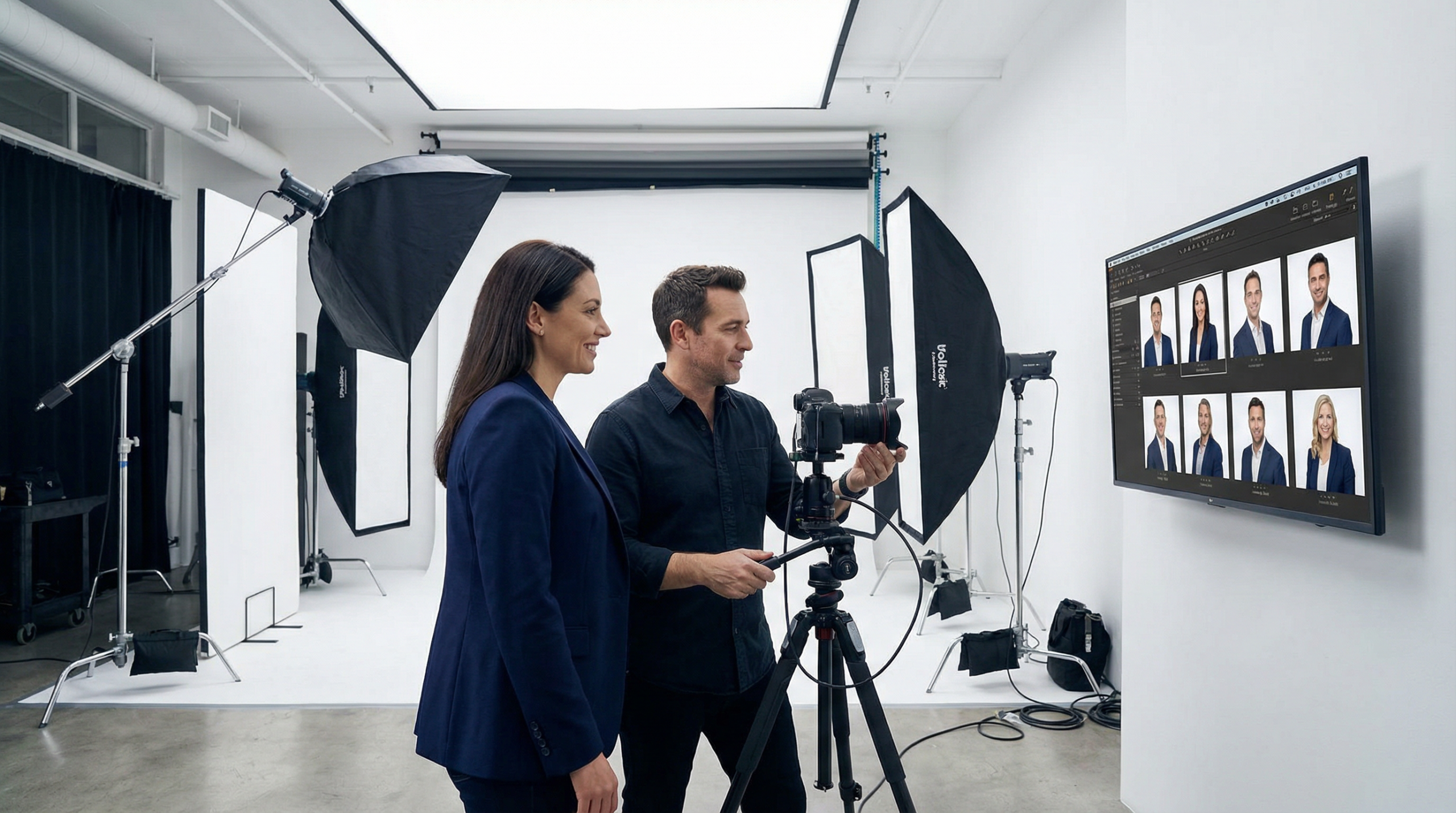
Why this question matters now
“Professional headshot” has become a confusing term. Some people mean a clean studio portrait. Others mean a bright, phone-shot image with a blurred background. Some mean “corporate,” while others mean “personal brand.”
In 2026, a headshot is professional if it performs a specific job: it communicates credibility quickly, looks consistent across modern platforms (LinkedIn, websites, internal directories, press pages), and holds up under scrutiny at multiple sizes—from a tiny avatar to a full website banner.
Professional does not mean stiff. It does not mean over-retouched. And it certainly does not mean trendy for the sake of trend.
This guide gives you a practical standard you can use to evaluate any headshot—whether you are booking a photographer, preparing for a session, or reviewing final images.
The 8-Point Professional Headshot Standard
A headshot is “professional” when it meets these eight criteria. If one or two are weak, you may still have a usable image. If several are weak, the image will quietly work against you.
1) It matches the expectations of your industry
Professional is contextual. A headshot for an attorney is judged differently than a headshot for a yoga studio owner. The image must signal, “I belong in this role.”
How to test it: Compare your image to 10 people in your field at the level you aspire to. If yours looks out of place—too casual, too dramatic, too trendy—it is not aligned.
2) The lighting is intentional and flattering
Lighting is the #1 differentiator between “professional” and “random.” Professional lighting:
- Maintains natural skin tone
- Avoids harsh shadows under eyes
- Separates you from the background
- Creates shape without exaggerating texture
Common failure mode: overhead lighting, mixed lighting (window + room lights), or flat lighting that makes the face look “wide” and lifeless.
3) The image is sharp where it counts
Professional sharpness is not about seeing every pore. It is about crisp eyes, clean edges, and a file that holds up across uses.
Minimum standard: eyes are in focus; no motion blur; no aggressive smoothing that destroys detail.
4) The background supports the subject, not the other way around
A professional background is not necessarily plain. It is quiet.
What “quiet” means: no bright highlights behind the head, no messy lines (door frames, shelves), no distracting text/logos unless deliberate for branding.
5) The crop and composition are platform-ready
Most headshots fail on LinkedIn not because they are bad portraits, but because the crop is wrong. Your face becomes too small, or the crop feels claustrophobic.
Professional composition: enough headroom; shoulders included; camera height is flattering; crop works as a circle avatar and as a rectangular website image.
6) The expression looks confident and natural (not performative)
A professional headshot reads as authentic confidence. That does not require a big smile. It requires the right balance of warmth and authority for your role.
Common failure mode: a “camera smile” that looks forced, or an expression that reads tired or guarded.
7) Wardrobe is clean, intentional, and non-distracting
Professional wardrobe is about fit, texture, and the absence of visual noise:
- Clean lines
- Good fit in shoulders and neckline
- Limited busy patterns
- Controlled shine (especially in suits and satin fabrics)
Common failure mode: wrinkled fabric, too-tight collars, bold patterns that moiré on camera.
8) Retouching is natural and identity-preserving
Professional retouching should reduce temporary distractions while preserving texture and identity.
A professional rule: if someone meets you and says, “You don’t look like your headshot,” retouching was too heavy—or styling/lighting was too extreme.
A Clearer Definition: “Professional” is Three Outcomes
If you want a simple test, use this:
A headshot is professional if it:
1. Looks credible at first glance
2. Looks like you in real life
3. Works across the platforms you actually use
That is it. Everything else is a means to those outcomes.
The Biggest Misconceptions About “Professional Headshots”
Misconception 1: “A professional headshot is expensive because it’s a photo.”
The cost is not the click. It is the system behind the result:
- Lighting control
- Posing direction
- Expression coaching
- Consistent editing
- Color accuracy
- File preparation for multiple uses
- And often a curated selection process
Misconception 2: “Professional means ‘corporate’ and stiff.”
Professional means “appropriate.” A modern, approachable headshot can be professional if it still meets the standard above.
Misconception 3: “Retouching makes it professional.”
Retouching should refine, not transform. If retouching is doing the heavy lifting, the lighting/posing/styling were not solved correctly in camera.
Misconception 4: “My phone portrait mode is good enough now.”
Sometimes it is usable—especially for casual contexts. But phone images commonly fail on:
- Mixed lighting and skin tone accuracy
- Inconsistent background blur artifacts
- Lack of shape/definition in the face
- Limited file consistency for web and print uses
If your headshot represents your business, your leadership role, or your credibility, “usable” is a low bar.
What to Ask a Headshot Photographer (So You Can Judge Professionalism)
You do not need to know camera gear. You need to know process.
Ask:
- How do you coach expression and posing?
- How do you handle glasses glare?
- What does retouching include, and what does it avoid?
- How do you ensure consistent skin tone and color accuracy?
- How do clients select final images—same day, online gallery, or guided reveal?
- Do you deliver crops optimized for LinkedIn and websites?
- If I need team consistency over time, can you match lighting/background later?
A professional headshot provider has clear answers, because repeatability is the product.
Edge Cases: When “Professional” Needs a Different Approach
Glasses
Professional headshots with glasses require lighting control and micro-adjustments. You should not be told to “just tilt your head” and hope.
Skin tone accuracy
Mixed lighting and poor editing often push skin tones too orange or too gray. A professional workflow preserves natural undertones.
Bald heads, shiny skin, and men’s grooming
Shine control and shaping light matter. Professional is not “matte everything.” It is balanced and natural.
Natural hair and textured hair
Professional means respecting texture, shape, and edges without over-smoothing or flattening.
Checklist: How to Know Your Headshot Is Truly Professional
Use this checklist on any final image:
- [ ] I look like myself on a great day
- [ ] My eyes are sharp and engaging
- [ ] Skin tone looks natural (not orange/gray)
- [ ] Background is quiet and not distracting
- [ ] Wardrobe is clean, fitted, and wrinkle-free
- [ ] Crop works as a small avatar and a website image
- [ ] Retouching is subtle and identity-preserving
- [ ] The image feels appropriate for my industry and role
FAQ
Is a white background always professional?
Not always. White can look clean, but it can also feel clinical or overly bright depending on wardrobe and skin tone. Neutral grays and soft tones are often more versatile.
How many final images count as “professional”?
Quality matters more than quantity. Most professionals need 1–3 strong images for common uses. Leaders and entrepreneurs often benefit from a small library.
What resolution do I need?
For web use, you need properly sized and optimized files. For print (press, brochures), you need higher resolution. A professional delivery includes correct exports for both.
Can I use the same headshot for years?
Only if you still look like it and it matches your current role. A good rule is update every 2–3 years, or sooner after major changes (hair, weight, glasses, role shift).