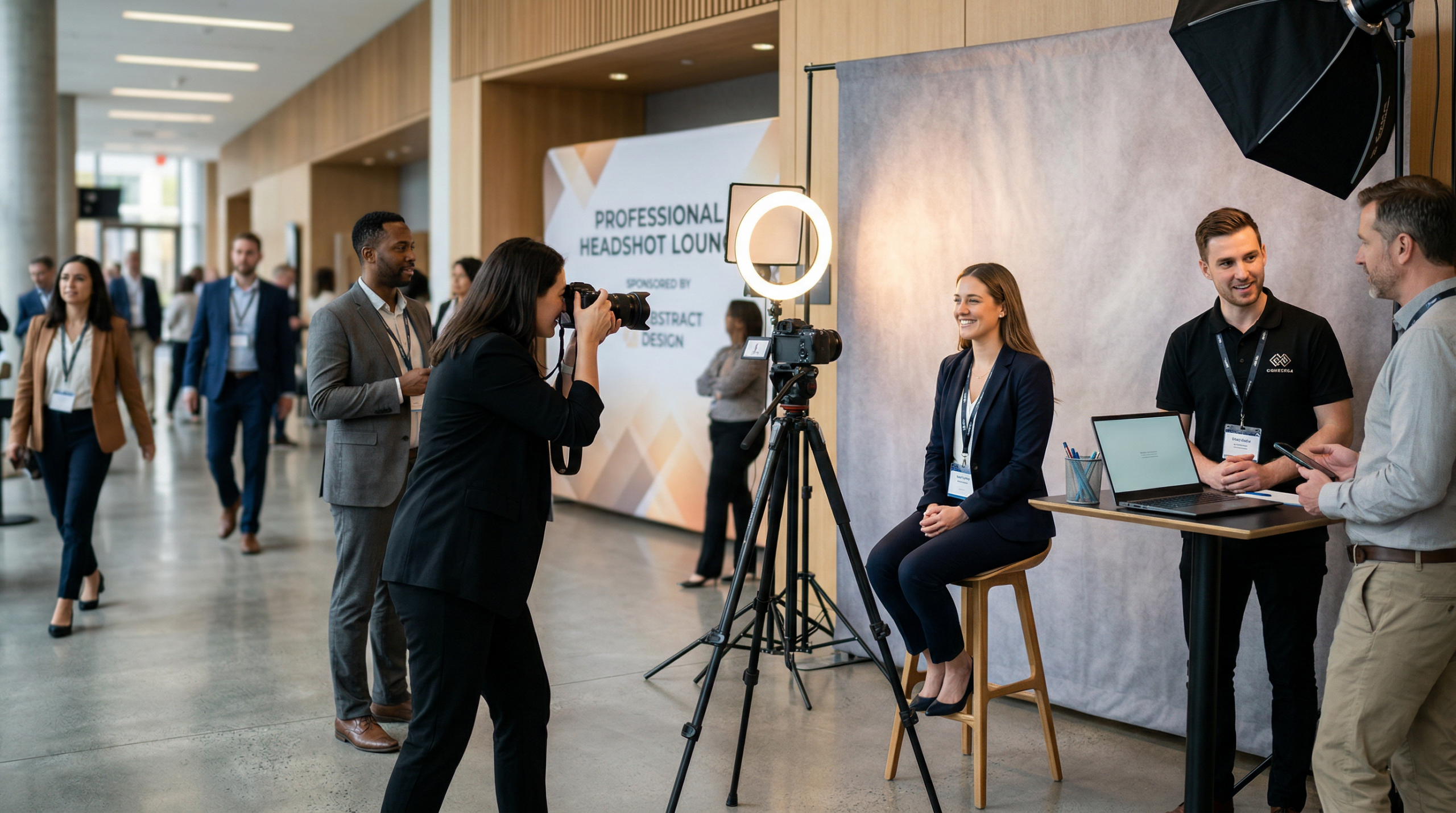
From the attendee side, a conference headshot station often looks simple.
There is a clean setup, a quick interaction, a few minutes in front of the camera, and then the attendee moves on with the promise of a polished professional image. When it is done well, it feels smooth, easy, and almost effortless.
That ease is real for the attendee, but it is never accidental.
Behind a professional conference headshot station is a great deal of planning, coordination, and control. The goal is not just to take good pictures. The goal is to create a reliable, polished experience inside a live event environment where time is limited, traffic is unpredictable, and expectations are high.
That is what people do not always see.
A strong headshot station is part portrait workflow, part event logistics, and part client experience design.
It starts before the event day
A professional conference headshot station is built long before the first attendee steps in front of the camera.
The process starts with planning.
That includes understanding the event type, the audience, the organizer’s goals, the sponsor context if there is one, the physical environment, the available space, the schedule, and how the station is supposed to function inside the flow of the event.
Without that planning, the station may still exist, but it will be more likely to feel improvised.
The strongest setups begin with questions like:
Who is this for?
What kind of attendee experience are we trying to create?
Is the station open flow, scheduled, or sponsor-supported?
Where should it be located?
What is the realistic throughput?
How will delivery work?
How should the station be promoted before and during the event?
These are not minor details. They shape everything else.
The location has to work for photography and flow
One of the least visible but most important parts of the process is location evaluation.
A spot that seems convenient on a floor plan may not actually work well once the event is live. A headshot station needs more than square footage. It needs functional space.
That means considering:
- attendee traffic
- line management
- visual clutter
- nearby distractions
- ceiling height if relevant
- access to power
- separation from heavy congestion
- whether the setup will feel inviting or intrusive
The challenge is that the best location is usually a balance, not an extreme.
Too hidden, and the station gets ignored. Too central, and it may create blockage or noise. Too close to a speaker room, registration bottleneck, or busy sponsor corridor, and the experience can become stressful for both attendees and staff.
What looks smooth on event day usually reflects smart location planning before event day.
The setup has to look polished and efficient
Attendees decide very quickly whether something feels worth their time.
That is why the physical setup matters so much. A professional station should look intentional, clean, and confidence-inspiring from the moment someone walks by.
That means:
- a backdrop that feels professional
- lighting that is consistent and flattering
- equipment arranged neatly
- a shooting area that looks organized
- a footprint that supports efficiency without feeling cramped
The station should communicate quality without feeling overly technical or intimidating.
Most attendees are not evaluating the gear. They are evaluating whether the experience feels professional and whether they trust the result will be worth doing.
A clean setup helps answer that question immediately.
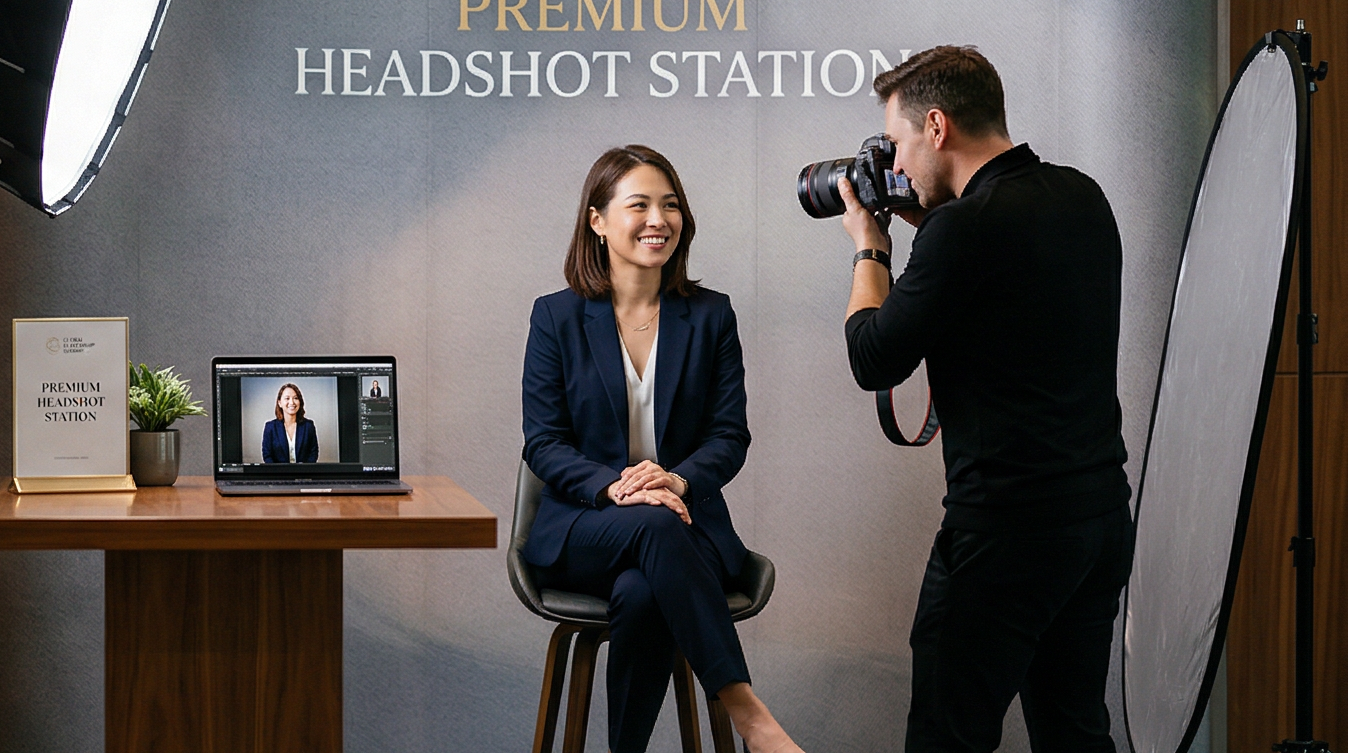
Lighting is one of the invisible difference-makers
Many people underestimate how much lighting shapes the success of a conference headshot station.
In a studio, lighting can be controlled more completely. At a conference, the photographer often has to create consistency in an environment that may include mixed ambient light, overhead lighting, shifting room conditions, and limited space.
That is why the lighting setup matters so much.
The goal is not just technical correctness. It is to create flattering, repeatable results quickly across many different faces, outfits, skin tones, and heights. A good setup needs to work efficiently from person to person without forcing constant reinvention.
This is one of the reasons a professional station feels different from a casual “photo booth” experience. The result is meant to look polished and credible, not merely fun or spontaneous.
Coaching is a major part of the real work
One of the biggest behind-the-scenes realities is that many people do not arrive feeling comfortable in front of the camera.
Some feel rushed. Some feel awkward. Some have not had a professional portrait in years. Some assume they are not photogenic. Some are comparing themselves to everyone else at the event.
This is where coaching becomes one of the most important parts of the job.
A strong headshot station depends on the ability to help people look confident quickly. That often means making small adjustments in:
- posture
- body angle
- chin position
- expression
- eye line
- energy level
It also means helping the person relax enough for the image to feel human rather than forced.
This is a hidden part of the value. Attendees may think they are just stopping for a quick photo, but what actually makes the result strong is often the combination of technical skill and efficient, reassuring direction.
The flow has to be built, not guessed
A station can have beautiful lighting and still fail if the attendee flow is weak.
Behind the scenes, a smooth station depends on knowing how people will move through it.
That includes:
- how they learn the station exists
- how they understand whether they can join
- where they wait
- how they step into position
- what happens during the session
- how they learn about delivery
- how questions are answered without disrupting the line
If these steps are unclear, the station becomes harder to use even if the photography is strong.
This is why operational clarity matters. A good headshot station should feel almost self-explanatory from the attendee perspective. The hidden work lies in making that simplicity possible.
Timing and pace have to be realistic
Another behind-the-scenes truth is that speed has limits.
People sometimes imagine that headshots can be produced at a near-assembly-line pace without affecting quality, but that assumption can create trouble. The most successful conference stations are efficient, but they are not careless.
Every attendee needs at least enough time for:
- quick positioning
- expression coaching
- several frames
- a usable final selection workflow
- clear next-step communication
The exact pace varies depending on the event, but the principle stays the same: realistic throughput creates a better experience than inflated promises.
When expectations are honest, the station feels organized. When throughput is exaggerated, the experience can turn into long lines, rushed interaction, and lower-quality results.
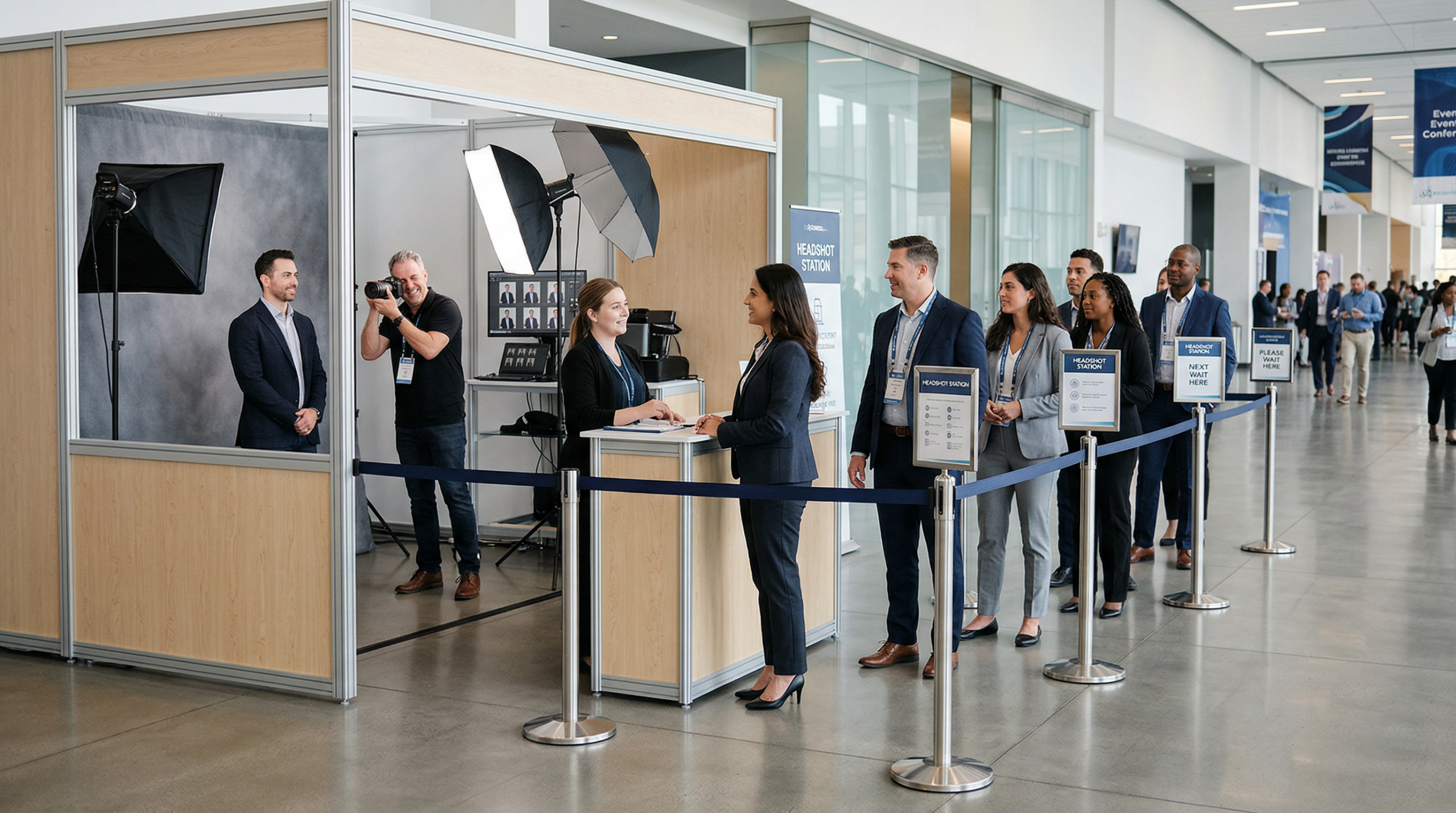
Signage and communication do a lot of hidden work
Attendees feel more confident when they understand what is happening.
That confidence often comes from things people barely notice consciously: clear signage, visible information, and smooth explanations.
Behind the scenes, that means deciding:
- how the station is labeled
- how the sponsor is acknowledged, if applicable
- how eligibility is explained
- how delivery timing is communicated
- how people know what to expect
These details reduce hesitation and repetitive questions. They also make the station feel more professional, because clarity is part of professionalism.
A poorly explained activation creates friction. A clearly explained one feels easy.
Delivery is part of the experience, not an afterthought
One of the biggest mistakes in conference headshot work is treating delivery as a separate administrative detail instead of part of the attendee experience.
It is not enough to photograph people well. They also need to know:
- what they are receiving
- when they will receive it
- how it will arrive
- whether it will be polished or retouched
- whether any action is required on their part
When delivery is vague, even a strong session can feel unfinished. When delivery is clear, the entire experience feels complete.
That is why the behind-the-scenes work includes not only capturing the images, but also planning the communication and follow-through around them.
Sponsor integration has to feel natural
If the station is sponsor-supported, that adds another layer of planning.
The sponsor should be visible enough to receive proper value, but not so dominant that the activation feels like an advertisement disguised as a service. That balance matters because the attendee’s positive experience is part of what makes the sponsorship valuable in the first place.
Behind the scenes, that means thinking through:
- signage language
- sponsor placement
- mention in event materials
- whether the station is adjacent to a sponsor area
- how sponsor acknowledgment appears in delivery or promotion
Good sponsor integration supports the experience. Poor sponsor integration can distract from it.
A professional setup protects the event experience
The best conference headshot stations do not just produce strong portraits. They protect the broader event experience.
They do not create chaos in the hallway. They do not confuse attendees. They do not block traffic. They do not feel visually sloppy. They do not leave people unsure of what happens next.
Instead, they fit into the event in a way that feels polished and intentional.
That is part of the value organizers are really buying. Not just images, but a headshot experience that works inside the event rather than fighting against it.
Why the behind-the-scenes work matters
Attendees may never see the planning conversations, the location decisions, the gear choices, the timing estimates, the sponsor coordination, or the delivery workflow.
But they feel the result of all of it.
They feel it when the station is easy to approach. They feel it when they are guided well. They feel it when the line makes sense. They feel it when the process is efficient. They feel it when the final image arrives the way they expected.
That is what behind-the-scenes work is really for.
It turns what could have been a clumsy setup into a professional experience.
Final thought
A professional conference headshot station is built on much more than a camera and a backdrop.
It depends on planning, flow, lighting, coaching, communication, realistic pacing, and thoughtful integration into the event itself. When those elements come together, the station feels seamless to attendees and valuable to organizers, sponsors, and participants alike.
That smooth experience is not accidental.
It is the result of intentional work that happens long before and long after the shutter clicks.
Plan a Professional Conference Headshot Station
If you want a conference headshot station that feels polished, professional, and easy for attendees to use, let’s talk about how to design the right setup for your event.
Explore More
- → What Makes an On-Site Headshot Station Run Smoothly at a Conference — LIVE BLOG URL PENDING
- → How a Conference Headshot Station Creates Real Sponsor Value — LIVE BLOG URL PENDING
- → Conference Headshots / Event Headshot Stations