When organizations plan a conference, summit, trade event, or leadership gathering, photography often gets grouped into one broad category: “We need a photographer.”
That sounds simple, but it usually hides an important distinction.
Conference headshots and event coverage are not the same service. They solve different problems, create different kinds of value, and support different business goals. If that distinction is not clear at the planning stage, organizers can end up with the wrong kind of photography for the outcome they actually wanted.
Some events need one or the other. Many benefit from both.
Understanding the difference helps event planners, marketing teams, sponsors, and organizers invest in the right experience for attendees and the right assets for future promotion.
What conference headshots are
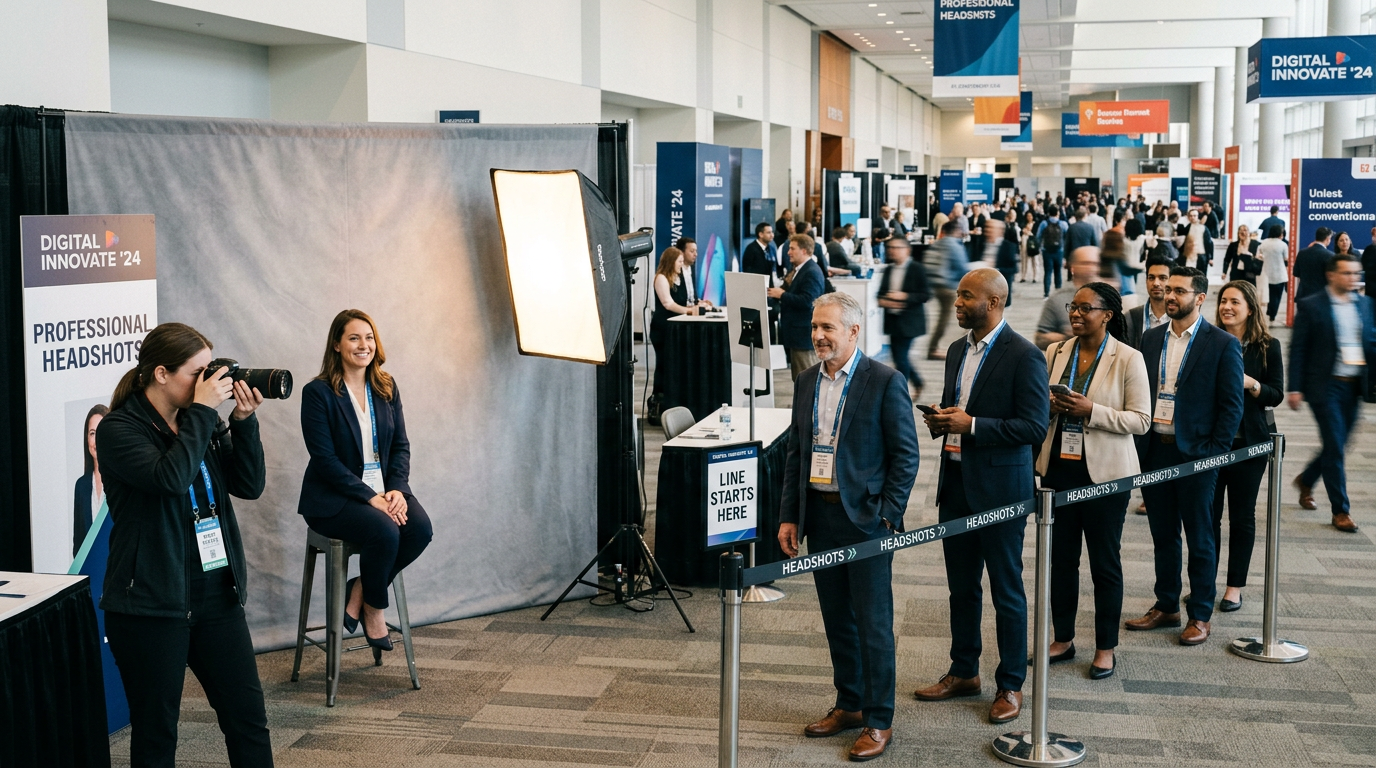
Conference headshots are professional portraits created on-site during an event. Instead of functioning as general event photography, they act as a focused attendee experience.
A conference headshot station is designed to give participants something useful and personal: a polished professional image they can use for LinkedIn, company websites, speaking profiles, internal directories, press features, and other business-facing needs.
This makes conference headshots more than a simple photo opportunity. They are an activation. They add attendee value in a way people immediately understand because the result has practical use long after the event ends.
For many attendees, a good headshot is not a luxury. It is something they have needed for months and never gotten around to updating. When an event makes that easy, the perceived value is high.
What event coverage is
Event coverage is different. Its purpose is to document the event itself.
That includes the people, the energy, the speakers, the interactions, the environment, the sponsor moments, the networking, and the branded details that tell the story of what happened. Event coverage creates visual assets that help organizations promote the event, recap the experience, support future registration, thank sponsors, feed social media, and strengthen internal communications.
If conference headshots are attendee-facing, event coverage is story-facing.
The audience for event coverage is often broader than the individual attendee. Marketing teams, event organizers, leadership, sponsors, and future prospects all benefit from strong event coverage because it shows the event in motion. It creates proof. It gives shape to the experience.
Why people confuse the two
The confusion usually comes from the assumption that “a photographer at the event” can cover everything equally well.
That assumption sounds reasonable, but it often breaks down in practice.
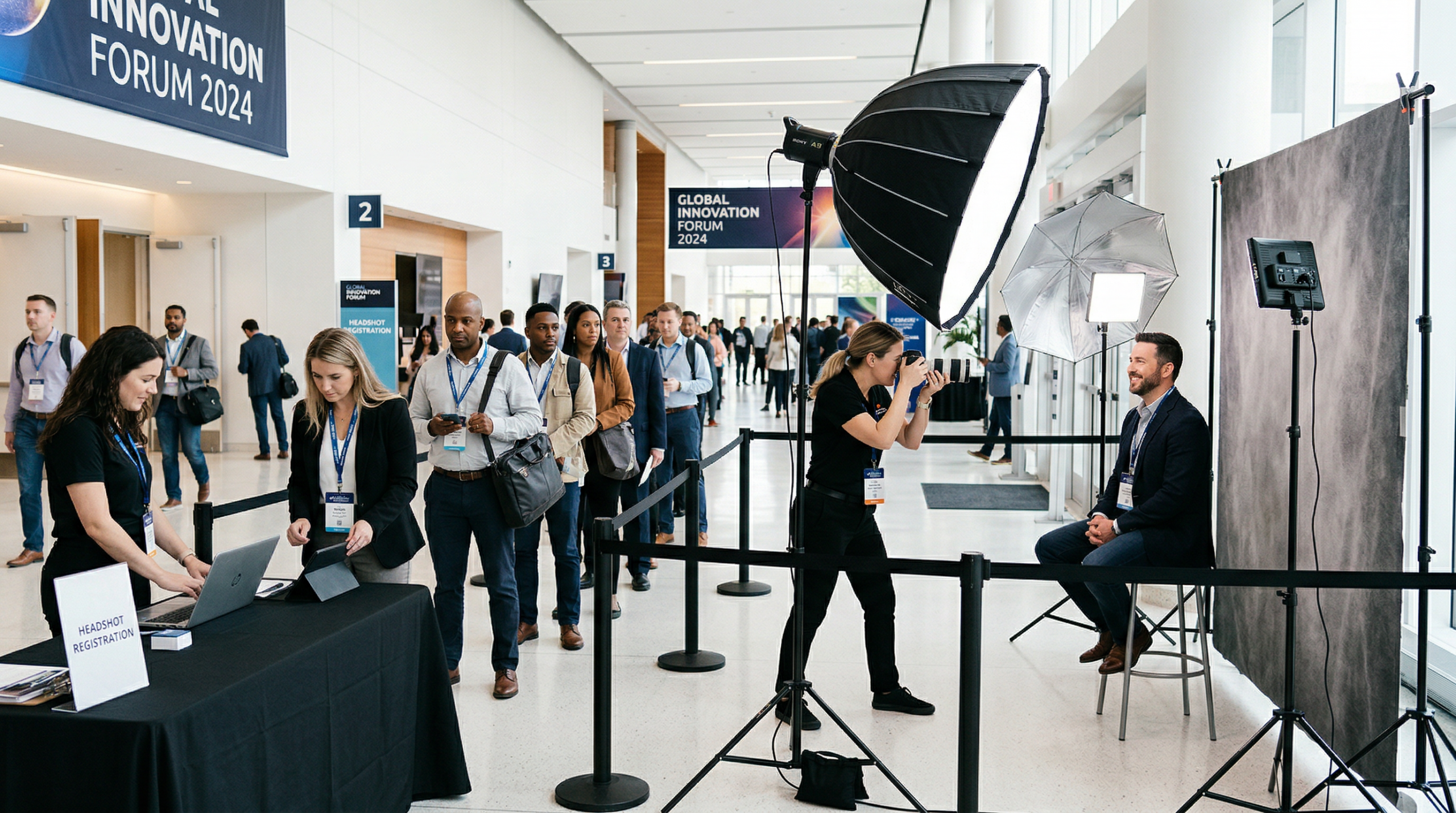
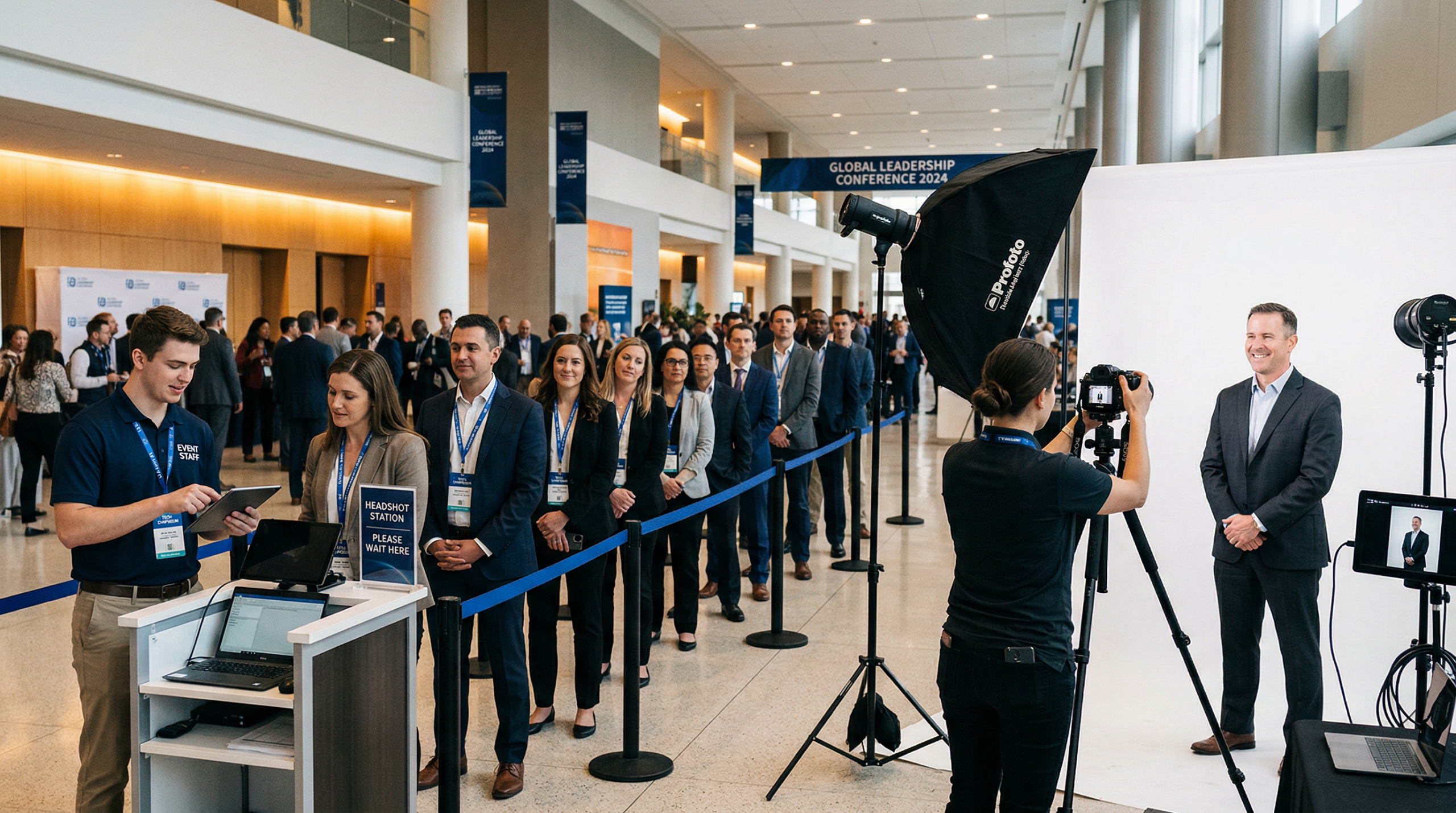
A professional headshot station needs structure. It requires controlled lighting, quick subject coaching, efficient flow, and a consistent process that makes each person look polished and confident. It is a portrait experience happening inside an event environment.
Event coverage works differently. It depends on anticipation, timing, storytelling awareness, and the ability to move through a live environment capturing moments as they happen. The goal is not consistency from subject to subject. The goal is to document the event honestly and usefully.
These are related skills, but they are not interchangeable in the way many planners assume.
What problem conference headshots solve
Conference headshots solve a very specific problem: they give attendees a professional image they can actually use.
That matters because today’s professionals are constantly visible online. LinkedIn profiles, company team pages, conference speaker bios, proposal decks, podcasts, webinar appearances, internal communication platforms, and recruiting materials all rely on visual first impressions.
When attendees walk away with an updated headshot, the event becomes associated with something personal, practical, and professionally valuable.
Conference headshots can also support:
- attendee engagement
- sponsor activation
- premium conference experiences
- recruiting events
- association conferences
- networking events
- leadership summits
- women’s leadership and professional development events
- trade show activations
In other words, the headshot station becomes part of the event’s value proposition.
What problem event coverage solves
Event coverage solves a different business problem.
Organizations need images that show what the event felt like, who attended, what the environment looked like, how sponsors were represented, how speakers engaged the audience, and how the brand showed up in the room.
Those images are useful for:
- post-event recap content
- future event promotion
- sponsor reports
- social media marketing
- website updates
- internal newsletters
- press outreach
- sales and sponsorship decks
Without event coverage, an organization may host a strong event and still have very little visual proof of it afterward.
That is why event coverage is often essential for organizations that want to build momentum from one event to the next.
When conference headshots are the better fit
Some events benefit most from conference headshots.
That is especially true when the event’s value is tied closely to professional development, networking, recruiting, or personal brand visibility. In those cases, attendees are likely to see direct benefit in a headshot station and engage with it quickly.
Conference headshots are often a strong fit for:
- professional associations
- conferences with strong career-development themes
- recruiting and hiring events
- women in leadership events
- networking conferences
- executive summits
- membership-based organizations
- sponsor-supported activations
If the event wants to offer attendees something memorable and genuinely useful, conference headshots are often one of the strongest photography investments available.
When event coverage is the better fit
Other events benefit more from coverage than portraits.
If the primary goal is to tell the story of the event, highlight speakers, show crowd energy, capture sponsor presence, or build a marketing library for future use, then event coverage should lead.
That is often true for:
- awards dinners
- company celebrations
- internal meetings
- speaker-heavy conferences
- fundraising events
- launch events
- branded activations
- events where recap and promotion matter more than attendee portrait value
In these situations, coverage is what preserves the event’s momentum after the room clears.
When you need both
Many conferences do not need to choose. They need both.
A well-planned event can use conference headshots to create attendee value while using event coverage to document the bigger story. One serves the participant. The other serves the organization.
Together, they create a more complete return on the event.
Headshots give attendees something useful and memorable. Event coverage gives organizers and sponsors the visual assets they need for marketing, reporting, and future promotion.
This combination is especially powerful for annual conferences, trade associations, sponsor-supported events, and any gathering where the attendee experience and the organization’s long-term visibility are both important.
The mistake planners often make
One of the most common mistakes is assuming that photography is just photography.
A planner hires general event coverage and later realizes there are no polished headshots for attendees, speakers, or leadership. Or they book a headshot station and later realize they have no visual story of the event itself.
Neither service failed. The mismatch happened at the planning stage.
That is why the first question should not be, “Do we need a photographer?”
The better question is:
What outcome do we need the photography to create?
That answer determines whether the event needs conference headshots, event coverage, or both.
A smarter way to plan it
The easiest way to make the right decision is to identify the main goal first.
If the goal is attendee value, professional usefulness, or sponsor-backed engagement, conference headshots may be the right fit.
If the goal is event storytelling, recap content, promotional assets, or sponsor visibility across the event as a whole, event coverage may be the right fit.
If both goals matter, the plan should reflect that from the beginning instead of forcing one service to act like the other.
Clear planning leads to better expectations, smoother execution, and more useful final images.
Final thought
Conference headshots and event coverage are both valuable, but they are valuable in different ways.
One gives attendees something they can use immediately in their professional world. The other gives organizers and sponsors the visual story they need to extend the life and impact of the event.
When the distinction is clear, it becomes much easier to invest in the right experience.
And when the event needs both, the smartest choice is to plan for both intentionally.
If you are planning a conference, summit, networking event, or corporate gathering and are not sure whether you need conference headshots, event coverage, or a combination of both, let’s map out the setup that fits your event goals.
Explore More
- Why Conference Headshots Outperform Cheap Swag at Corporate Events — LIVE BLOG URL PENDING
- What Makes an On-Site Headshot Station Run Smoothly at a Conference — LIVE BLOG URL PENDING
- Conference Headshots / Event Headshot Stations